
A plain-English guide to converting your unpaid invoices into working capital — and what it costs you to do it.
Factoring is a financial service that allows a business to convert outstanding invoices into immediate cash. Instead of waiting for your customers to pay on 30, 60 or 90-day terms, you sell those invoices to a factoring company at a discount.
The result is working capital in your account today, funding the salaries, stock, fuel and supplier payments that can't wait for a debtor's accounts department.
Critically, factoring is not borrowing. You are not taking on a loan against future earnings — you are accelerating money that has already been invoiced and earned. That distinction is why it doesn't sit on your balance sheet as debt.
"You've delivered. You've invoiced. Factoring means you don't have to wait ninety days to spend the money."
The mechanics are simple, and designed to sit alongside how you already trade.
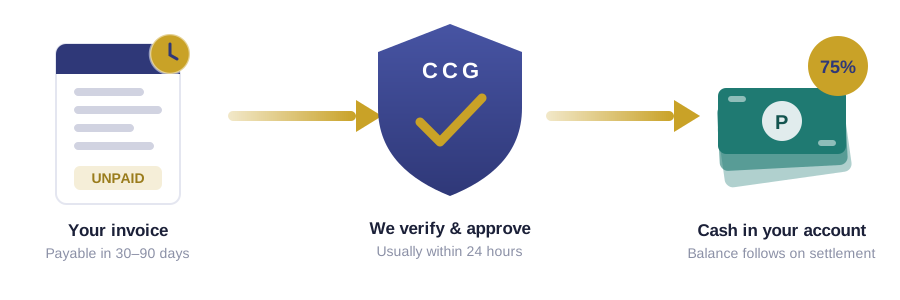
You provide goods or services to your customer, exactly as you do today.
An invoice is issued to the customer on your normal payment terms.
You submit that invoice to Capital Chambers Group. We verify it and assess the customer's credit standing.
Up to 75% of the invoice value is advanced to you, typically within 24 hours of approval.
Once your customer settles, you receive the remaining balance less the agreed factoring fee.
Not every arrangement carries the same protection or the same cost. Understanding the difference is the most important decision you'll make.
Your business retains some of the risk. If the customer ultimately fails to pay, the invoice comes back to you and the advance is repaid or offset against future invoices.
The risk of non-payment on approved invoices shifts entirely to us. If your customer defaults for reasons of insolvency, that loss is ours and not yours.
A single invoice, factored on its own, with no requirement to commit your whole sales ledger or sign a long-term agreement.
The complete package: funding plus outsourced credit control. We run credit checks on your customers, manage collections and report back on your ledger.
Two products extend the same principle — one changes who starts the arrangement, the other changes where the buyer sits.
Ordinary factoring is supplier-led: you sell your own invoice. Reverse factoring flips that. The buyer establishes the programme, approves invoices as valid, and we settle with their suppliers early — at a rate priced off the buyer's credit standing rather than the supplier's.
The same mechanics applied across a border. Selling to a customer in another country introduces two problems a domestic facility never faces: judging the creditworthiness of a buyer under a different legal system, and collecting from them when payment is late.
Factoring offers real advantages for businesses of every size — particularly those growing faster than their cash cycle allows.
Immediate access to cash that is otherwise tied up in your invoices for months at a time.
Under a non-recourse arrangement, the risk of customer non-payment transfers to us.
The facility grows with your business, unlike a traditional loan with a fixed limit.
Factoring is not a loan, so there is no debt recorded on your balance sheet.
| Factoring | Bank loan / overdraft | |
|---|---|---|
| Speed | Cash within 24 hours of approval | Weeks of application and review |
| Security | The invoice itself | Often property or personal guarantees |
| Limit | Scales with your invoicing | Fixed, renegotiated periodically |
| Balance sheet | No debt recorded | Recorded as a liability |
| Assessed on | Your customers' credit strength | Your own trading history and security |
That's a normal place to start. Tell us how you invoice and who you invoice, and we'll walk you through the options honestly — including when factoring isn't the right answer.